Coinbase's CEO Fired Software Engineers Who Didn't Adopt AI Tools: 'We're Leaning as Hard as We Can Into AI' Software engineers at Coinbase were asked to explain to the CEO directly why they weren't using AI coding tools (on a Saturday). If they didn't have a good reason, they were fired.
By Sherin Shibu Edited by Melissa Malamut
Key Takeaways
- Coinbase, a $77.4 billion platform that enables users to buy, sell, and store cryptocurrencies, has made an internal push to adopt AI.
- Coinbase CEO Brian Armstrong said this week that he fired employees who didn’t onboard to AI coding tools like Cursor and Copilot.
- The company generates 33% of new code with AI, with the goal of getting to 50% by the end of September.
The CEO of $77.4 billion cryptocurrency platform Coinbase enforced a recent AI push by firing employees who failed to onboard with new AI tools by a strict deadline.
Coinbase CEO Brian Armstrong told the "Cheeky Pint" podcast earlier this week that he showed his staff how serious he was about AI adoption at the company.
Armstrong said he "mandated" the use of AI coding tools internally earlier this year, and Coinbase employees told him that it would take up to six months to get 50% of the software engineers on staff to use the AI tools.
But Armstrong decided to accelerate that timeline.
He told software engineers to learn the AI tools by the end of the workweek. They didn't have to use the tools every day; just get familiar with them. Engineers who failed to onboard had to meet with Armstrong on a Saturday to explain why they hadn't. Those without a good reason were fired.
"I jumped on this call on Saturday, and there were a couple of people who had not done it," Armstrong said on the podcast. "Some of them had a good reason, because they were just getting back from some trip or something, and some of them didn't, and they got fired."
It's unclear how many employees were fired out of Coinbase's 4,200-person workforce.
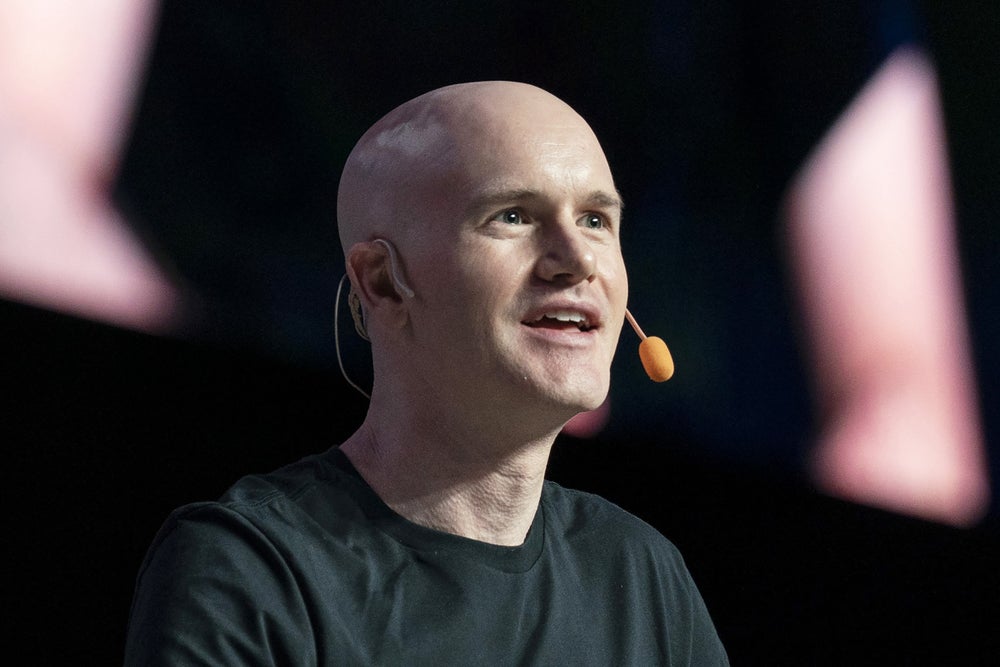 Coinbase CEO Brian Armstrong. Photographer: Bryan van der Beek/Bloomberg via Getty Images
Armstrong said that the firings were related to a broader push to use AI.
"Like a lot of companies, we're leaning as hard as we can into AI," Armstrong said on the podcast. "We made a big push to get every engineer on Cursor and Copilot," he added, referring to two popular AI coding tools that generate code from prompts, edit code, and debug programs.
Armstrong mentioned that though some employees didn't like his "heavy-handed approach," it set the tone and provided clarity about the company's priorities. Now 33% of Coinbase's code is written by AI, with the goal of hitting 50% by the end of the quarter in September, he said.
Related: Perplexity CEO Says AI Coding Tools Cut Work Time From 'Four Days to Literally One Hour'
Other companies are also generating comparable amounts of code with AI. Google CEO Sundar Pichai stated in April that Google is using AI to write "well over 30%" of all new code at the company, while Microsoft CEO Satya Nadella stated in the same month that AI generates 20% to 30% of new code at Microsoft.
Many companies in the U.S. are mandating that employees use AI tools. Perplexity, an AI search engine startup valued at $14 billion, made it "compulsory" for engineers to use Cursor or Copilot earlier this year, and saw measurable outcomes. CEO Aravind Srinivas told Y Combinator last month that the AI tools reduced "experimentation time" from "three, four days to literally one hour."
"That level of change is incredible," Srinivas stated.
AI coding tools are also gaining popularity. Cursor hit one million users in April since its launch last year and exceeded $500 million in annual revenue by June. Meanwhile, GitHub Copilot reached more than 20 million users last month.